
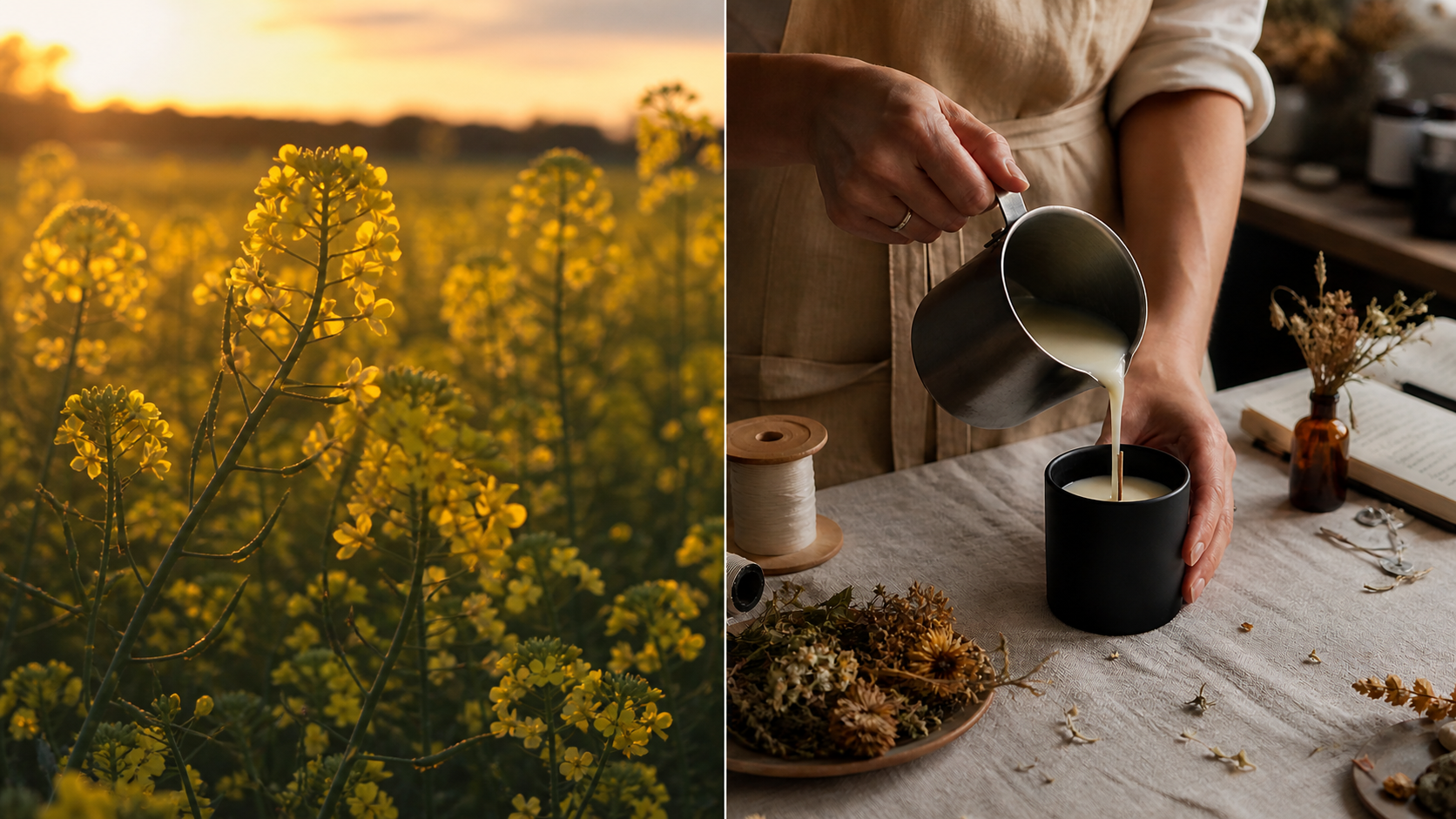
If you walk into any candle shop in the UK and ask for something sustainable, you’ll be steered straight at soy. It’s become the default green answer the way oat milk became the default green coffee. But the picture is more complicated than that.
This piece is for anyone who actually cares about the answer. We’ll compare the three plant-based candle waxes you’re most likely to encounter — soy, rapeseed and coconut — across the things that genuinely matter: where they come from, what they cost the planet to produce, and how they burn. No paid sponsorships, no chest-thumping — just the real comparison we wish was easier to find when we were sourcing our own wax.
Why we are not even talking about paraffin
Paraffin is a petroleum byproduct. It burns dirtier (more soot, more particulate matter), it’s a non-renewable resource, and there is no reasonable sustainability story to tell about it. Most cheap supermarket candles are paraffin or paraffin-blend. We don’t use it, and if a candle is sold as “eco” without specifying its wax type, assume it’s a paraffin blend until proven otherwise.
Soy wax
The case for it: Soy is plant-based, biodegradable, and burns cooler than paraffin so the candle lasts longer. The wax is widely available, cheap to produce, and most candle-making suppliers carry it as their flagship.
The case against it: Most commercial soy comes from large-scale monocrop farming in the US, Brazil and Argentina, which is one of the leading drivers of deforestation in the Amazon and the Cerrado. A “clean” UK candle made from imported soy may have travelled 8,000 miles before it reached your living room. There’s also the GMO question (most commercial soy is genetically modified) and the herbicide question (soy farming is heavily reliant on glyphosate).
None of that makes soy bad — it makes soy complicated. If you can find UK or EU-sourced soy from a certified non-GMO supplier, the picture improves a lot. Most candles can’t make that claim.
Rapeseed wax
The case for it: Rapeseed (also called canola) grows widely across the UK and Europe — you’ve probably driven past acres of those bright yellow fields. That means a much shorter supply chain than soy, lower transport emissions, and (crucially) no link to tropical deforestation. The wax burns clean and cool, holds fragrance well, and doesn’t need much in the way of additives.
The case against it: Conventional rapeseed farming uses pesticides, including neonicotinoids that have been controversial for their effect on bee populations (these are now restricted in the EU/UK but the legacy matters). Organic rapeseed is harder to source. The wax also tends to be more expensive than soy because the supply chain is smaller.
The argument for rapeseed is mostly about locality — if you live in the UK, a UK-grown wax with a 200-mile supply chain is hard to beat for footprint.
Coconut wax
The case for it: Coconut wax has the best burn quality of the three. It pools beautifully, throws scent strongly even from a relatively cool flame, and produces almost no soot. Coconut palms also yield more wax per acre than soy or rapeseed, which is a big deal in carbon-per-litre terms.
The case against it: Coconut wax travels. The wax has to come from tropical countries (Philippines, Indonesia, Sri Lanka) where coconut palms grow, so the supply chain is long. There’s also a labour-conditions question to think about — some coconut-producing regions have serious worker-rights issues, so look for fair-trade or directly-sourced suppliers.
Pure coconut wax is also expensive and notoriously soft, which is why almost no candle is made from 100% coconut wax — it’s nearly always blended with another wax for structural integrity.
Side by side
Lowest carbon footprint (UK consumer): Rapeseed (UK-grown) wins on transport. Coconut wins on yield-per-acre but loses on shipping. Soy depends entirely on origin — UK or EU soy is fine, US/South American soy is not great.
Best burn quality: Coconut wax. Followed by a coconut-blended wax. Pure soy or pure rapeseed is decent but not as smooth.
Best scent throw: Coconut, then rapeseed-coconut blend, then soy.
Best price: Soy is cheapest, rapeseed is mid, coconut is most expensive.
Best for sensitive noses or homes with kids/pets: All three are far better than paraffin. Rapeseed and coconut tend to throw scent more cleanly without the “chemical” edge that low-quality soy can have.
What we use at Pop and Vibe (and why)
We use a rapeseed-and-coconut blend in every candle. The rapeseed comes from European farms with a short supply chain. The coconut wax brings burn quality up to where we want it — smooth pools, clean flame, generous scent throw. The blend gives us the best of both: a low-footprint base wax with a high-performance burn.
We don’t use soy because we couldn’t find a UK-grown source we were comfortable with at scale, and we didn’t want to ship US soy across the Atlantic to make “sustainable” candles. We don’t use paraffin because it’s a step backwards. We don’t use pure coconut because the wax structure is too soft for tinned candles to ship safely in a UK summer.
The rapeseed-coconut blend isn’t the only good answer to candle sustainability — it’s the answer that makes sense for our product, our customers, and our supply chain. A small UK soy candlemaker who sources non-GMO European soy is making a perfectly good choice too. The villain isn’t soy or coconut or rapeseed — it’s candles that don’t tell you what they’re made of at all.
FAQ
Is soy wax actually bad for the environment?
Not inherently. The issue is supply chain. Soy from large monocrop farms in deforested areas of Brazil is genuinely problematic. Soy from a UK or EU farm is fine. The wax itself is plant-based and biodegradable.
Is coconut wax better than soy?
Better burn quality, yes. Better sustainability story, only sometimes — coconut has to be shipped from the tropics, while UK-grown soy doesn’t.
What about beeswax?
Excellent burn quality, beautiful natural honey scent, but expensive and not vegan. We didn’t cover it here because it’s a different category — if vegan isn’t a priority for you, beeswax is a solid choice from a small UK apiary.
How can I tell what wax a candle is made of?
Read the product description. Reputable candle brands name their wax explicitly. If a candle just says “wax” or “natural wax,” assume it’s a paraffin blend.
The bottom line
Pick the wax whose sustainability story you can tell. If a candle brand can’t answer where its wax comes from in a sentence, that’s the answer. Browse our candles — every wax origin is on the product page, every burn time is published, and every tin is reusable.
Curious what a rapeseed and coconut blend smells like? Try our Lavender & Vanilla for a calm, classic burn or our Sandalwood & Lily for something more grown-up. Both hand-poured in small batches in Britain.
